
CRE announced our support for the Task Force on Climate-related Financial Disclosure (TCFD) in June 2022.
The TCFD Recommendations encourage the disclosure of information in line with four disclosure pillars—Governance, Strategy, Risk Management, and Metrics and Targets—in order to accurately identify how risks and opportunities associated with climate change affect corporate management, including financials. We will continue to work to further enhance our information disclosure based on the four disclosure items required by the TCFD Recommendations. In addition, we reaffirm that our efforts to address climate change contribute to the sustainable development of society and to the enhancement of our medium- to long-term corporate value, and we will further promote our sustainability initiatives.
- Progress after June 30, 2022 is reported as needed on this page.
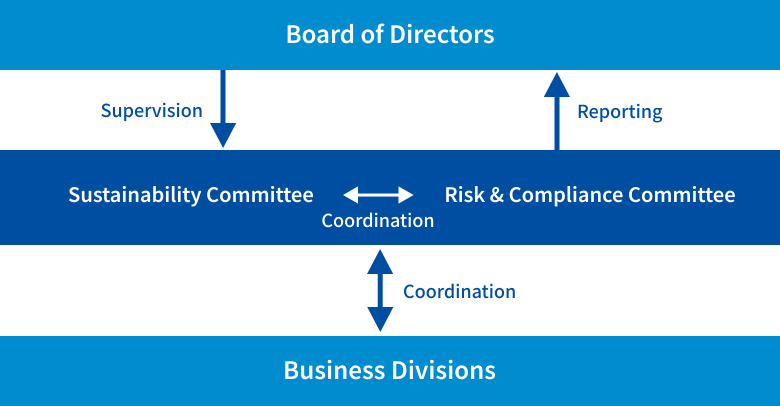
We recognize that addressing climate change and environmental issues is an important management priority. With regard to these issues, the Sustainability Committee, in cooperation with the Risk & Compliance Committee, discusses twice a year the assessment and management of risks and opportunities associated with climate change, measures to achieve targets, and SDGs-related initiatives, and reports to the Board of Directors as necessary. In principle, the Board of Directors oversees the progress of initiatives related to TCFD and SDGs that have been discussed and approved in the course of business execution, and places matters related to these issues on its agenda at least once a year.
The Sustainability Committee, under the supervision of the Board of Directors and chaired by the Representative Director and President, will promote the continuous enhancement of sustainability activities.
|
Organization and meetings |
Roles |
|
Board of Directors |
The Board of Directors oversees the progress of initiatives related to TCFD and SDGs that have been discussed and approved in the course of business execution. Matters related to TCFD and SDGs are placed on the agenda at least once a year. |
|
Risk & Compliance Committee |
The Committee is composed of the Representative Director and President, full-time directors, division heads as stipulated in internal regulations, the head of the Internal Audit Office, and external experts such as lawyers and certified public accountants appointed by resolution of the Committee. In cooperation with the Sustainability Committee, the Committee identifies comprehensive risks, including environmental issues, twice a year, discusses countermeasures, and reports to the Board of Directors as necessary. |
|
Sustainability Committee |
The members consist of the Representative Director and President, division heads as stipulated in internal regulations, directors and executive officers of the Group appointed by division heads as stipulated in internal regulations, the heads of relevant departments, and external committee members. The Committee discusses the assessment and management of climate-related risks and opportunities, measures for achieving targets, and SDGs-related initiatives at least twice a year, and reports to the Board of Directors as necessary. |
|
Business Divisions |
Business divisions work with each committee to address matters resolved by each committee. |
Based on the TCFD recommendations, we conducted a scenario analysis to identify the risks and opportunities associated with climate change. In the scenario analysis, we defined a 1.5°C scenario and a 4°C scenario based on scientific evidence from the International Energy Agency (IEA) and other sources, and assessed the significance of climate-related risks and opportunities that could affect our business as of 2030.
|
Scenarios set |
1.5°C Scenario |
4°C Scenario |
|
Worldview |
The Japanese government is promoting strict climate change measures, such as the introduction of a carbon tax, which will bring about fundamental social change and require responses to plastic regulations and climate change-related information disclosure. On the other hand, damage from natural disasters such as floods and inundation will remain limited. |
The government will not implement climate measures beyond the current level, and climate change response will not be required. On the other hand, rising temperatures are expected to lead to abnormal weather events such as droughts and floods, potentially damaging facilities and increasing response and recovery costs. |
|
Reference scenarios |
IEA The Net-Zero Emissions by 2050 Scenario(NZE)/ IEA World Energy Outlook 2021/ IEA World Energy Outlook 2018/ IPCC AR6 SSP1-1.9 |
IEA World Energy Outlook 2021/ IEA World Energy Outlook 2018/ IPCC AR6 SSP5-8.5 |
|
Features |
Transition risks related to policies are likely to materialize. |
Physical risks related to extreme weather are likely to materialize. |
We examined the transition and physical risks related to climate change for our Logistics Investment and Real Estate Management businesses and assessed the degree of impact on our business. We examined a wide range of items, including, for transition risks, matters ranging from policies and regulations to changes in the market, and, for physical risks, acute and chronic physical risks. We will address risks and opportunities that we judge to have a significant impact on our Company.
Scope: Domestic Logistics Investment and domestic Real Estate Management businesses
[Impacts]
Large: The impact is very significant (29% or more of sales)
Medium: The impact is significant (17–29% of sales)
Small: The impact is limited, though present (less than 17% of sales)
Of the risks and opportunities recognized by the Company, those with a medium or higher impact on our business are listed below.
|
Type of risk / opportunity |
Description of risks / opportunities |
Business and financial impact |
|||
|
1.5°C |
4°C |
||||
|
Risks |
Transition Risks |
Policy / Legal |
A significant increase in carbon tax will increase the cost of raw materials with large emission sources (steel, cement, etc.) |
Medium |
|
|
If the scope of compliance with energy conservation standards is expanded or the standards are raised, this could lead to increased costs for development properties |
Medium |
||||
|
Market |
Declining investment and financing due to stakeholder concerns over weak ESG practices |
Medium |
Medium |
||
|
Physical Risks |
Acute |
Fluctuations in land prices against the backdrop of medium- to long-term climate change impacts, leading to intensified competition for land acquisition and additional bidding costs |
Medium |
Medium |
|
|
Frequent heavy rains and inland flooding cause construction work at logistics facilities to be suspended, resulting in construction delays |
Large |
Large |
|||
|
Abnormal weather events such as localized heavy rain, heavy snow, and typhoons can damage suppliers’ manufacturing facilities, halting operations, and disrupt transportation routes such as road closures, resulting in delays to construction schedules |
Large |
Large |
|||
|
In the development of logistics facilities in coastal areas, costs for embankments and BCP measures to address sea level rise and storm surges will increase |
Medium |
Medium |
|||
|
Due to the frequent occurrence of weather disasters such as localized heavy rain, heavy snow, typhoons, and floods caused by abnormal weather, design standards for stormwater treatment facilities and structural calculations will become stricter, resulting in increased costs |
Medium |
Medium |
|||
|
If a natural disaster occurs and an owner’s warehouse is damaged, the owner may be unable to cover the repair costs and may decide to abandon the warehouse, resulting in a decrease in the number of properties under management |
Large |
Large |
|||
|
Chronic |
On extremely hot days, on-site work becomes difficult, resulting in increased countermeasure costs and construction delays |
Medium |
Medium |
||
|
Opportunities |
Transition opportunities |
Market |
Rising demand for logistics facilities with high environmental performance leads to a competitive advantage |
Medium |
Medium |
|
As modal shift progresses, opportunities for logistics facility development increase, leading to higher demand |
Medium |
Medium |
|||
|
Physical opportunities |
Acute |
Developing logistics facilities with enhanced disaster response capabilities will secure a competitive advantage, leading to increased rental income and more inquiries from tenants |
Medium |
Medium |
|
|
Risks / opportunities |
Business impact |
Quantitative details |
2030 * The financial impact amount due to extreme weather events is estimated for 2050. |
|
|
1.5℃ |
4℃ |
|||
|
Carbon tax |
Increase in tax burden due to the introduction of a carbon tax |
Costs |
Approx. 10 million yen |
- |
|
Fluctuations in crude oil prices (commercial vehicles) |
Increase/decrease in costs due to rising gasoline prices resulting from changes in crude oil prices*1 |
Costs |
Approx. -16 million yen |
Approx. 6 million yen |
|
Energy mix changes |
Increase/decrease in electricity costs due to changes in the energy mix |
Costs |
Approx. 0.6 million yen |
Approx. -0.6 million yen |
|
Extreme weather (flood risk) |
Loss of profit due to suspension of operations at sales offices*2 |
Sales |
Approx. -19 million yen |
Approx. -37 million yen |
|
Approx. -348 million yen (maximum loss) |
||||
-
With respect to crude oil price fluctuations, the calculation takes into account only price changes attributable to climate change and does not factor in geopolitical risks.
-
Both the maximum impact amount in the event of a single disaster and the impact amount taking into account the probability of occurrence are considered.
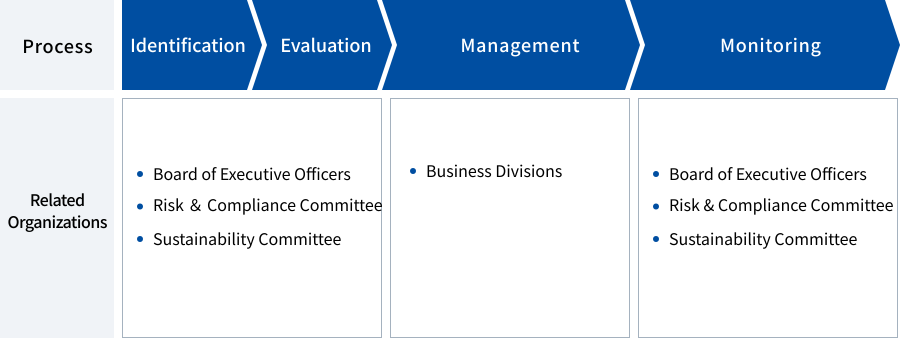
To build a sustainability framework, we have established company-wide risk management regulations and set up a Sustainability Committee to address sustainability issues in general, including climate change. In particular, risks associated with climate change will be identified and assessed by the Sustainability Committee in cooperation with the Board of Executive Officers and the Risk & Compliance Committee. Thereafter, each business division will manage (respond to) these risks, and the Sustainability Committee will monitor them in cooperation with the Board of Executive Officers and the Risk & Compliance Committee.
We calculate greenhouse gas emissions as an indicator for assessing climate change-related risks and opportunities. We will continue to monitor greenhouse gas emissions and will work to establish systems and set targets that will enable us to expand the scope of coverage and reduce emissions.
For information on our Company’s greenhouse gas emissions, please see below.